 September 22, 2026 ·
Contents
- What the choice of ad channel depends on
- Google Ads: when the user is already searching for a solution
- When Google Ads might not be the right fit
- Meta Ads: when you need to build or expand demand
- TikTok Ads: when the product can be shown through content
- TikTok Search: how search inside the platform is changing
- Google, Meta, or TikTok: comparing tasks, not platforms
- Or maybe you don't need Google, Meta, or TikTok at all?
- How to choose an advertising channel for your business
- Example: why the same CPL can be bad or good
- Why you shouldn't launch every platform at once "just to test"
- What if you use several channels?
- Which channel for which business: examples by type
- What to do with a small ad budget
- How to tell if an ad channel is actually working
- Bottom line: there's no single best platform
- Frequently Asked Questions
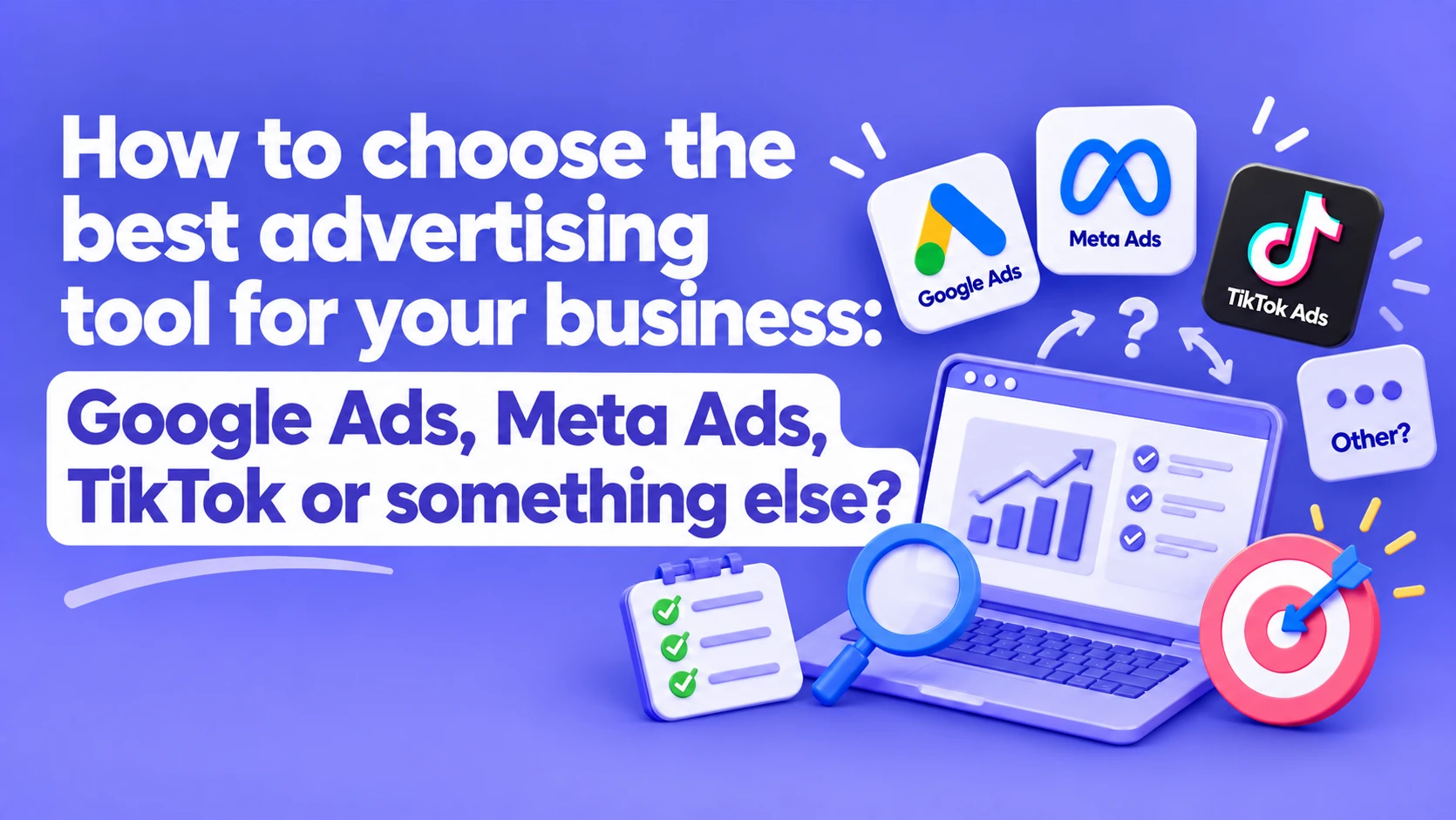
Google Ads, Meta Ads, and TikTok Ads are often compared as competing advertising platforms. But the question "which is better: Google, Meta, or TikTok?" isn't quite the right one — each channel has its own logic for reaching users.
Google more often lets you work with existing demand: someone is already searching for a product, service, or solution. Meta can create demand through visual content, interests, behavior, and user signals. TikTok puts a strong emphasis on a discovery model, where a user discovers a product through content rather than arriving with an already-formed request.
That said, a business doesn't have to pick just one platform. Depending on the product, a combination can be more effective: Google Ads + Meta Ads, or Meta Ads + TikTok Ads + Google Ads, and sometimes the main channel ends up being SEO, email marketing, YouTube, marketplaces, affiliate placements, or other sources.
So the right question is: where is your potential audience already spending time, and how do they make a purchase decision?
What the choice of ad channel depends on
Before launching ads, you need to answer at least seven questions:
- What exactly are you selling?
- Who is your customer?
- Is someone searching for your product right now?
- How long is the decision cycle?
- Does the product need explaining first?
- Can it be shown visually?
- How much can the business pay to acquire a customer?
The last question matters most. Even a large ad budget can't compensate for a situation where the product's economics don't allow buying customers at the current cost. So the ad channel should be chosen together with the business's economics, not separately from it.
Google Ads: when the user is already searching for a solution
Google Ads is especially logical for products and services with existing search demand — for example, buying an AC unit, booking an apartment renovation, a dentist nearby, buying industrial equipment, hiring accounting services, renting office space, flower delivery.
The user has already formulated a need and typed a query. Google Search Ads matches user search queries with advertisers' keywords and ads (more in Google Ads Help on the Search Network). So the strength of search advertising isn't just the number of impressions — what matters here is user intent. The person doesn't necessarily know your company, but they already know they need something.
When Google Ads can be especially useful
Google is worth considering first if: people are actively searching for your product; there are commercial search queries; the service has a clear name; the customer wants to solve a problem right now; there's local demand; the product can be bought through the website; the business is B2B; the company has a clear landing page.
For example, if someone searches "buy oak countertop Sarasota" and your company sells exactly that, search ads let you reach them at the moment the need is already there.
When Google Ads might not be the right fit
The limitation: if people don't yet know about the product or aren't searching for it, Search Ads may have a physically limited demand volume.
Imagine a new product that just launched. The user doesn't know its name and isn't searching for it on Google, because they don't yet realize they need this exact product. In that situation you may first need to create demand. That's where Meta Ads, TikTok, YouTube, and other channels come in.
Meta Ads: when you need to build or expand demand
Meta Ads covers advertising across the Facebook and Instagram ecosystem (more in Meta Business Help on ad placements). Unlike a classic search scenario, a user typically doesn't come to the platform with the intent "I need your company right now." They're scrolling the feed, watching content, chatting, exploring topics they're interested in — and the ad appears within that process.
That's why Meta is often used for e-commerce, apparel, cosmetics, furniture, home goods, local services, educational products, events, subscription products, lead generation, and content promotion.
Creative plays an especially important role here. On Meta, defining an audience isn't enough — you need to give the person a reason to stop scrolling. That could be an unusual product demo, a customer problem, a specific offer, a comparison, a case study, a review, before/after, or explaining a complex product in simple terms.
When Meta can be more interesting than Google
For example, you sell a new kitchen product. The person might not search for "new kitchen organizer" at all. But they might stop scrolling on a video that shows a storage problem and demonstrates a solution — meaning the user didn't have a formed query; the ad itself created the interest.
That's the core difference: Google often works with existing demand, and Meta can help create and grow demand. Meta can also be used for retargeting, working with existing audiences, and reconnecting with people who've already interacted with the business.
TikTok Ads: when the product can be shown through content
TikTok shouldn't be treated only as a platform for a "young audience." Today TikTok's ad system includes tools for traffic, lead generation, conversions, audience work, and search. TikTok is also developing Search Ads Campaign, where ads can appear in TikTok's search results for specific keywords.
So TikTok is more than short viral videos, but content and discovery still play a major role in how a user first encounters a product.
TikTok can be worth considering if the product is easy to demonstrate on video, generates visual interest, connects to trends, has a clear before/after effect, solves a common problem, is easy to explain in a short clip, or has organic-reach potential.
For example, "Here's why your ads aren't generating leads" can be more natural TikTok content than a dry ad like "Order your ad setup."
TikTok Search: how search inside the platform is changing
TikTok is already developing separate Search Ads Campaigns that let you use keywords to run ads in TikTok's own search results. As of 2026, this format supports the Traffic, Sales, Lead Generation, and App Promotion objectives (more in TikTok's About Search Ads Campaign article).
This means the line between a "social network" and a "search platform" is getting blurrier. A user might first see a video, then get interested in the product, and then search for more information right inside TikTok. So when choosing a channel today, consider how search is evolving inside these platforms, too.
Google, Meta, or TikTok: comparing tasks, not platforms
This isn't a universal effectiveness matrix. The same channel can perform completely differently for two companies in the same niche.
Or maybe you don't need Google, Meta, or TikTok at all?
Yes. Sometimes it's more advantageous for a business to start with a different source.
SEO
SEO can be especially interesting for businesses with steady search demand, a high-ticket product, customers who research offers for a long time, lots of informational queries, and a willingness to invest in content over the long run. SEO doesn't replace PPC in every case, but it can become an important additional source of organic traffic.
YouTube
YouTube is worth treating separately from ordinary social media ads. It's especially useful where the product needs explaining — complex equipment, SaaS, education, financial products, hardware, B2B, expert services. Video lets you show how the product works. YouTube can also help build demand, warm up an audience, and support later retargeting.
For B2B, LinkedIn can be a separate channel, especially when you need to reach a professional audience by job title — company owners, department heads, procurement, HR, IT specialists, marketers, CFOs.
But here, weigh lead acquisition cost against customer value. If a single contract is worth $20,000 to the business, the cost of a quality B2B lead can be judged very differently than for a $50 product.
Marketplace advertising
If a company sells through a marketplace, it can sometimes make more sense to start with advertising inside that marketplace itself. The user is already in an environment where they're searching for a product, comparing offers, checking prices, reading reviews, and ready to buy. In that case, outside traffic isn't always the first channel worth testing.
How to choose an advertising channel for your business
You can use a simple sequence.
Step 1. Is there existing demand?
If someone is already searching for your product, start by checking search advertising. Demand exists → Google Ads can be a logical candidate.
Step 2. Can interest be created through creative?
If the product is easy to show, explain, or demonstrate, consider Meta and TikTok. Visual potential exists → Meta / TikTok.
Step 3. Does the product require a long explanation?
If the buyer needs a lot of information, YouTube + Google + SEO + retargeting can help.
Step 4. How long is the sales cycle?
For a $20 purchase, someone might decide within minutes. For $50,000 equipment, the decision can take weeks or months. The longer the cycle, the more important a system of repeat touchpoints becomes: content → ads → retargeting → case studies → repeat contact → sale.
Step 5. What do the customer economics look like?
You need to know the average order value, gross margin, acceptable CAC, site conversion rate, lead-to-sale conversion rate, LTV, and repeat purchases. Without this, you can't properly evaluate an ad channel.
Example: why the same CPL can be bad or good
Picture two companies.
Company A. Average order value: $100. Margin: $30. Lead cost: $20. Lead-to-sale conversion: 10%. That works out to a customer cost of roughly $20 ÷ 10% = $200. That model can be economically difficult.
Company B. Average order value: $5,000. Margin: $2,000. Lead cost: $100. Lead-to-sale conversion: 10%. Customer cost: $100 ÷ 10% = $1,000. Here the situation is completely different.
So the phrase "leads are expensive on this platform" doesn't say much on its own. What matters is how much the customer costs, how much they bring the business, and what margin remains after the sale.
Why you shouldn't launch every platform at once "just to test"
Sometimes a business decides: "Let's launch Google, Meta, and TikTok and see where it's cheaper." The problem is that cheap clicks or leads don't necessarily mean cheap sales.
On top of that, each platform needs its own creatives, its own campaign logic, different audiences, correct analytics, a sufficient volume of data, and time to optimize. With a small budget, splitting money across three platforms can mean none of them gets enough data. In that case, it's smarter to identify a core hypothesis, test it, and only then expand the media mix.
What if you use several channels?
Then each channel gets its own role. Google captures existing demand. Meta creates additional demand and brings visitors back. TikTok provides new reach and discovery through video. YouTube explains a complex product. SEO accumulates organic search traffic. Retargeting brings back users who've already interacted with the company. Together they form a single funnel.
Example system for a furniture online store: Google Search (people search for specific furniture) → Google Shopping (the user sees the product and price) → Meta Ads (new collections, interiors) → TikTok (short videos of products and the manufacturing process) → SEO (articles answer buyers' questions) → retargeting (bringing back people who already visited the site) → CRM (working with people who submitted a request but haven't bought yet). This is already a complete customer acquisition and return system.
Which channel for which business: examples by type
- Online store: Google Ads + Meta Ads + retargeting.
- Local service: Google Search + Google Maps/Business Profile + Meta Ads.
- B2B: Google Ads + LinkedIn + content + retargeting.
- New product: Meta Ads + TikTok Ads + YouTube + content.
- Complex equipment: Google Search + SEO + YouTube + retargeting.
You can also think more broadly: for SaaS, a mix of Google Ads, YouTube, SEO, Meta Ads, and LinkedIn usually works well; for a new product, Meta Ads, TikTok Ads, YouTube, and influencer marketing. These are reference points, not a guarantee — the exact channel mix always depends on the product and audience.
What to do with a small ad budget
With a small budget, I wouldn't start with "which platform should I spend money on?" First, figure out where the most obvious demand is.
If people are actively searching for the service on Google, it makes sense to check Search first. If demand still needs to be created and the product is easy to show through video, consider Meta or TikTok. If the business is B2B with an expensive deal, it may be worth combining Google, LinkedIn, content, and direct sales. If it's e-commerce, you can test several channels at once, but only with sufficient budget and solid analytics.
How to tell if an ad channel is actually working
Don't judge a channel only by CPM, CTR, CPC, click count, or cheap leads. You need to look deeper: impressions → clicks → visits → leads → qualified leads → sales → revenue → profit.
For example, Meta brought in 200 leads, Google brought in 50. At first glance, Meta looks better. But after checking the CRM: Meta — 200 leads → 10 sales; Google — 50 leads → 15 sales. At that point, cost per lead alone doesn't give you the full answer. So ad platforms need to be judged by business results, not just ad-account metrics.
Bottom line: there's no single best platform
Google Ads, Meta Ads, TikTok Ads, YouTube, SEO, LinkedIn, and other channels solve different problems.
Google Ads is worth considering when there's existing search demand. Meta Ads can be useful for visual promotion, demand creation, lead generation, e-commerce, and retargeting. TikTok Ads is especially interesting for discovery, content promotion, and products that work well in short video — and TikTok is already building out keyword-based search advertising too. YouTube can be useful when a product needs to be shown or explained in detail. SEO builds up organic search traffic over time. LinkedIn can be relevant for certain B2B tasks. Marketplaces can be a logical ad channel for products that are already sold on those platforms.
So the choice shouldn't be based on "which platform is trending right now?", but on "where is my customer, what's their intent, and what's their path from first contact to purchase?" Only after that should you choose the ad channel, budget, format, and analytics system.
A good ad channel isn't the one with the cheapest click. It's the channel that, within your specific business model, can bring in users, turn them into customers, and leave the business with an economically justified result.
Not sure which channel to choose for your business? Before launching ads, you can analyze the product, audience, existing demand, competitors, and customer acquisition economics. After that it becomes clearer what to test first — Google Ads, Meta Ads, TikTok Ads, or a mix of several channels.
Frequently Asked Questions
What's better — Google Ads or Meta Ads?
There's no single right answer: Google Ads is more effective where search demand already exists, while Meta Ads works better where demand needs to be created through visual content. For many businesses, a combination of both works well.
What's better for advertising — TikTok or Instagram?
It depends on the product and audience. Instagram (part of Meta Ads) works well with precise interest-based targeting and retargeting, while TikTok works well with a discovery model and organic content spread. Many businesses test both channels in parallel.
When should you use Google Ads?
Google Ads is especially logical when people are already searching for your product or service — meaning demand already exists and just needs to be captured.
Is TikTok Ads a good fit for business?
Yes, if the product can be clearly shown on video or has a visual/emotional appeal. TikTok is also developing Search Ads Campaign with Traffic, Sales, Lead Generation, and App Promotion objectives, which extends its use beyond a purely discovery-based format.
Which ads work best for an online store?
For e-commerce, a mix of channels usually works best — for example, Google Ads (Search + Shopping) together with Meta Ads and retargeting, sometimes with TikTok Ads added in.
Which ads work best for B2B?
For B2B with clear search demand, Google Ads works well; for reaching specific job titles and industries, LinkedIn is useful. With a long sales cycle, add content and retargeting on top.
How do I choose an ad channel for my business?
Work through the sequence: check whether demand already exists; assess whether interest can be created through creative; understand how much explanation the product needs; factor in the length of the sales cycle; and, most importantly, calculate the economics — how much the business can afford to pay per customer.
Can I use several ad platforms at the same time?
You can, and often should — but with a small budget it's better to first test one main hypothesis and gather enough data, rather than spreading the budget across three platforms at once.
Not sure where to start with advertising for your business?
I'll analyze your product, audience, demand, and customer acquisition economics — and suggest which channel is worth testing first.
Get in Touch Website auditLanding Page Audit Before Running Ads: What to Check So You Don't Waste Your Budget26.10.2026
 Google Ads & Meta AdsHow Much Do Google Ads and Meta Ads Setup and Management Cost?26.10.2026
 InstagramInstagram Shadowban: How to Check It, Why Reach Dropped, and What to Do20.10.2026
 BudgetsMinimum Advertising Budget: Google Ads, Meta Ads, and TikTok Ads in 202621.09.2026
 Retargeting & AudiencesOrganic Traffic + Retargeting: How to Turn Free Website Visitors into Customers21.09.2026
 Google Merchant CenterGoogle Merchant Center: A Complete Setup and Product Review Checklist24.09.2026
 Choosing a ContractorFreelancer or Agency: What's Better for Business Advertising?08.10.2026
 Meta AdsWhy Meta Rejects Your Ads: The Main Causes and What to Do25.09.2026
 Ad Account AuditAd Account Audit: A Complete Checklist for Google Ads and Meta Ads25.09.2026