 September 21, 2026 ·
Contents
- What is organic traffic
- Why organic traffic alone is often not enough
- How the organic traffic + retargeting chain works
- Which audiences are worth collecting
- Google Ads: collecting audiences via Google Tag
- Meta Ads: building an audience with Pixel
- TikTok Ads: Pixel and site audiences
- Why organic traffic is especially valuable for retargeting
- You don't need to show everyone the same ad
- Using SEO to build ad audiences
- What to collect through GTM
- How to build such a system in practice
- The main mistake: treating all organic traffic as high quality
- Free traffic doesn't mean free marketing
- What happens if you don't collect audiences at all
- Organic traffic + paid advertising = one funnel
- What matters from a privacy standpoint
- The bottom line
- Frequently Asked Questions
Getting traffic to your site doesn't have to rely only on ads. SEO, Google Search, social media, YouTube, articles, expert content, and other organic sources can regularly bring people to your site who are already interested in your product or service.
But not every visitor buys or submits a request on the first visit. Someone might land on your site, look at a few pages, check prices, compare offers, and close the tab. That doesn't necessarily mean their interest in the product disappeared.
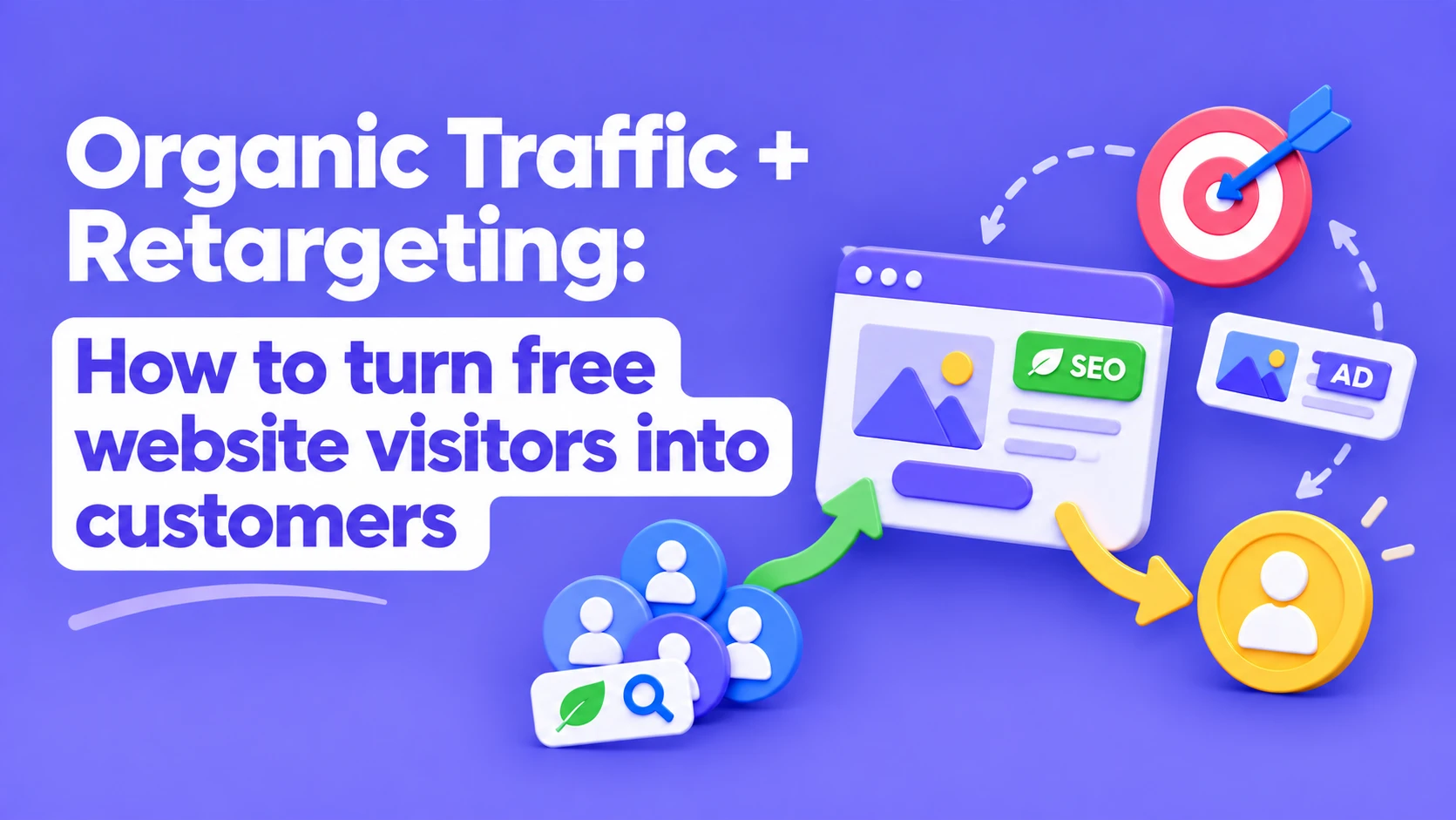
This is where the chain comes in: organic traffic → audience collection → retargeting → repeat contact → conversion. This way, organic traffic supports current sales and also builds an audience for future ad campaigns.
What is organic traffic
Organic traffic is visitors who arrive without a direct payment for each click. Sources can include Google and other search engines, SEO articles, informational queries, YouTube, social media, Telegram, expert content, recommendations and external links, and branded search queries.
For example, someone searches Google for "how to choose a solid wood countertop." They find a company's article, read it, and visit the site. A sale might not happen at that moment. But if analytics and ad tags are set up correctly, that visit can be used to build an audience. As a result, one organic visit becomes a potential customer the company can keep working with.
Why organic traffic alone is often not enough
A user's path rarely looks like: saw it → visited → bought. It's much more often: search → article → site → researching the product → comparing → leaving the site → searching again → returning → request or purchase.
This is especially noticeable in niches with a high average order value, a long decision cycle, lots of competitors, a need to compare offers, a complex product, B2B sales, or services that require a consultation.
So marketing's job isn't always to get a sale on the first visit. Sometimes the goal of that first contact is to get a quality visitor and preserve the ability to reach them again.
How the organic traffic + retargeting chain works
The mechanics look like this:
- A user arrives from an organic source — for example, Google, an SEO article, YouTube, or social media.
- Analytics tools and ad tags fire on the site — depending on the platforms, this could be Google Tag, Meta Pixel, or TikTok Pixel.
- The user lands in the relevant audience — all site visitors, visitors of a specific page or category, people who viewed a product, added a product to the cart, started filling out a form, or visitors who didn't purchase.
- An audience segment is built — once enough users accumulate, it can be used for ad campaigns, if the platform's rules allow it and the audience size meets its requirements.
- The user gets a repeat contact — for example, they see an ad with a different offer, a new product benefit, a case study, reviews, or a special deal.
So paid advertising isn't necessarily used to find someone from scratch. It can be used to bring back someone who already got to know the company.
Which audiences are worth collecting
One common mistake is building only an "all site visitors" audience. For proper retargeting, it's better to split users by behavior.
- All visitors — good for a general site audience, but it contains people with very different levels of interest.
- Visitors of a specific page — for example, a service page, a product category, a specific collection, or a pricing page. This audience is already much more precise.
- Viewed a product but didn't buy — for e-commerce, one of the clearest groups; the ad message can be made much more relevant.
- Added a product to the cart — a deeper funnel stage where a separate offer or reminder can help.
- Visited the contact page — especially useful for services; the person already reached information about the company.
- Submitted a request or made a purchase — it's often worth excluding these users from certain campaigns so budget isn't spent on people who already completed the target action.
Google Ads: collecting audiences via Google Tag
Google uses the term data segments for audiences of users who have already interacted with a company. Google Tag lets you collect site visitors into such segments and use them in ad campaigns. In Google Ads , you can build audiences based on site visits and specific user actions — for example, all visitors, visitors of a specific section, people who viewed a product, added a product to the cart, or converted users (more in Google Ads Help on creating an audience segment).
For more detailed work, Google also lets you pass events and parameters through an event snippet — this is especially important for e-commerce and dynamic remarketing. Data segments can be used beyond classic Display retargeting: in Search, YouTube, and other Google ad surfaces, depending on the campaign type and audience availability.
Meta Ads: building an audience with Pixel
In Meta is similar. Meta Pixel is installed on the site and used to pass events and build audiences for ad work (more in Meta for Developers' docs on Custom Audiences). In practice, you can split users by action: all visitors → viewed the product → added to cart → started checkout → purchased.
This way, you don't show the same ad to everyone. For example, someone who only read an article can be shown an ad about the product's benefits, while someone who already looked at a specific product can be shown that exact product or additional information about it. Account for privacy settings, user consent, and legal requirements around collecting and using data.
TikTok Ads: Pixel and site audiences
TikTok also lets you use site data to build ad audiences. TikTok Pixel passes events from the site into the ad system. Based on that, you can create audiences of users who visited the site or performed specific actions — TikTok explicitly lists Website Traffic as one of the sources for Custom Audiences used in retargeting (more in TikTok Ads Manager's About Website Traffic article).
Audience size matters here: TikTok requires a minimum of 1,000 matched users to use a Custom Audience in an ad group (more in TikTok Ads Manager's About Custom Audiences article). So installing the Pixel isn't enough — the audience still needs to build up to a usable size. For more reliable event delivery, TikTok also supports pairing Pixel with the Events API.
Why organic traffic is especially valuable for retargeting
Picture an online store. In a month, the site gets 10,000 organic visitors. Say only 1% make a purchase — that's 100 orders. But the remaining 9,900 users aren't necessarily wasted traffic.
Among them could be people comparing products, waiting for payday, choosing between a few companies, planning to come back later, still researching specs, who forwarded the link to a partner or manager, or who just weren't ready to buy on that particular visit. If the technical setup is right, some of these users can be collected into audiences and used for further retargeting.
The same organic traffic can work for the business more than once. First, the user arrives through SEO. Then they can be brought back with ads. After a purchase, they can be excluded from the ad audience or moved to a separate segment for further communication.
You don't need to show everyone the same ad
Each segment is a different stage of the user's journey.
Using SEO to build ad audiences
One model that works well: SEO article → useful content → site visit → audience → retargeting → commercial page → request.
For example, a company sells professional equipment. A user searches "how to choose manufacturing equipment" and finds the company's expert article. The article isn't a hard sell — its job is to give useful information and bring the user to the site. The user then explores a few more materials and lands in the site's visitor audience.
A few days later, they can be shown an ad: "Still choosing equipment? See real specs and configurations." The person comes back to the commercial page. This way, SEO and advertising become parts of one funnel.
What to collect through GTM
Google Tag Manager is a convenient technical layer for managing tags and events. Through GTM, you can organize the delivery of necessary events to various ad and analytics systems: page views, product views, button clicks, form submissions, checkout starts, purchases, category views, contact page visits.
GTM doesn't create audiences by itself. It helps correctly manage the installation and delivery of tags and events. It's the ad systems that then use the resulting data for their own audiences and ad scenarios.
How to build such a system in practice
- Step 1. Identify organic traffic sources — Google, SEO, YouTube, Instagram, Facebook, TikTok, Telegram, external sites.
- Step 2. Set up analytics — understand visitors' actions, not only their counts (GA4, Google Tag Manager, ad tags).
- Step 3. Install ad tags — Google Tag, Meta Pixel, TikTok Pixel, and server-side integrations and APIs where needed.
- Step 4. Configure events — don't stop at PageView; track what actions users take after landing on the site.
- Step 5. Create segments — for example: 0–30 days all visitors; 0–14 days viewed a product; 0–7 days added to cart; 0–30 days visited the contact page; a separate buyer audience for exclusion or repeat sales.
- Step 6. Launch retargeting — once enough audience has built up, you can test different messages for different segments.
The main mistake: treating all organic traffic as high quality
Organic traffic alone doesn't guarantee sales. 10,000 visitors from search can be less valuable than 1,000 users with commercial intent. So look beyond traffic volume and analyze which pages people visit, how much time they spend on the site, what actions they take, which sources drive conversions, which queries bring in users, which audiences come back, and how many users reach commercial pages.
For example, one article might drive 20,000 visits but generate almost no requests, while another brings 2,000 visitors and far more people who move on to the product. So SEO traffic needs to be judged on more than just volume.
Free traffic doesn't mean free marketing
Organic traffic doesn't require paying for each click the way PPC advertising does. But SEO, content creation, a specialist's work, site development, and analytics all cost money. So it's more accurate to say: organic traffic reduces a business's dependence on constantly paying for each visit, rather than making marketing completely free. Still, the accumulated audience can become an additional marketing asset.
What happens if you don't collect audiences at all
Say a user arrived from Google, looked at a product, and left. If no audience-collection system is set up, the chance for a repeat ad contact with that user through the relevant platform may be lost. But if tags and events are set up in advance, every new visitor potentially adds to the right segments.
So it makes sense to collect audiences before you need them. You can't decide to launch retargeting and then expect a large audience to appear overnight — it has to be built up.
Organic traffic + paid advertising = one funnel
The full model looks like this: content → organic traffic → site visit → Pixel / Google Tag → audience segmentation → retargeting on Meta / TikTok / Google Ads → repeat visit → request or purchase → excluding the buyer or moving them to a separate segment.
This approach lets you stop thinking of SEO, content, and paid advertising as fully independent tools. They can work sequentially.
What matters from a privacy standpoint
Collecting data for ad audiences must comply with applicable legal requirements, the specific ad platform's policy, and user consent settings. You can't just install every possible tag and consider the matter closed.
Check in particular: cookie consent, what data is being sent, what events are being fired, what parameters are being passed, whether there are restrictions for your specific business category, how your privacy policy is set up, and how you handle user requests to opt out of personalized advertising. Technically correct setup and legally correct data handling are two different tasks, and both need to be addressed.
The bottom line
Organic traffic can do more than bring one-off visits. With the right setup, it can build audiences for further work in ad systems. Google lets you build data segments from site visitors via Google Tag, Meta uses Pixel and site events to work with audiences, and TikTok supports Website Traffic Custom Audiences via Pixel and other web data connections.
The logic of promotion shifts: not just "brought someone to the site → got a pageview → lost the user," but "brought in organic traffic → captured the interaction → built a relevant audience → brought the user back with ads → got them to a request or purchase." So treat setting up Pixel, Google Tag, GTM, events, and audiences as part of the advertising strategy, not a technical formality.
Frequently Asked Questions
What is organic traffic retargeting?
It's a chain where visitors who arrive on a site for free (through SEO, social media, YouTube) are collected into ad audiences via Google Tag, Meta Pixel, or TikTok Pixel, and are then brought back to the site using paid advertising.
Do I need a Pixel if all my traffic is organic?
Yes. Organic traffic is especially valuable for retargeting — these people have already shown interest in the product without any click cost, and a Pixel/Google Tag keeps you from losing that audience for future campaigns.
How many visitors do I need for TikTok Ads retargeting?
TikTok requires a minimum of 1,000 matched users in an audience before it can be used in an ad group.
How are Google Ads "data segments" different from the old "remarketing"?
It's a renaming of the same mechanism: Google updated its interface terminology, so what used to be called remarketing and audience types is now called "your data" and "audience segments."
Can I set up retargeting without an ad budget?
You can collect audiences (install Pixels and tags) without running active ads — and it's worth doing that in advance. But showing retargeting ads still requires an ad budget on the chosen platform.
Want to set up a funnel like this for your site?
I'll check what's already set up on your site and suggest which audiences are worth collecting first for your specific niche.
Get in Touch Website auditLanding Page Audit Before Running Ads: What to Check So You Don't Waste Your Budget26.10.2026
 Google Ads & Meta AdsHow Much Do Google Ads and Meta Ads Setup and Management Cost?26.10.2026
 InstagramInstagram Shadowban: How to Check It, Why Reach Dropped, and What to Do20.10.2026
 BudgetsMinimum Advertising Budget: Google Ads, Meta Ads, and TikTok Ads in 202621.09.2026
 Choosing a ChannelHow to Choose the Best Advertising Tool for Your Business: Google Ads, Meta Ads, TikTok, or Something Else?22.09.2026
 Google Merchant CenterGoogle Merchant Center: A Complete Setup and Product Review Checklist24.09.2026
 Choosing a ContractorFreelancer or Agency: What's Better for Business Advertising?08.10.2026
 Meta AdsWhy Meta Rejects Your Ads: The Main Causes and What to Do25.09.2026
 Ad Account AuditAd Account Audit: A Complete Checklist for Google Ads and Meta Ads25.09.2026